1

Showing posts with label Amazing. Show all posts

Saturday, May 25, 2013

Gateshead Millennium Bridge

The Gateshead Millennium Bridge is a pedestrian and cyclist tilt bridge spanning the River Tyne in England between Gateshead's Quays arts quarter on the south bank, and the Quayside of Newcastle upon Tyne on the north bank. The award-winning structure was conceived and designed by architects Wilkinson Eyre and structural engineers Gifford. The bridge is sometimes referred to as the 'Blinking Eye Bridge' or the 'Winking Eye Bridge' due to its shape and its tilting method. In terms of height, the Gateshead Millennium Bridge is slightly shorter than the neighbouring Tyne Bridge, and stands as the sixteenth tallest structure in the city.

The Gateshead Millennium Bridge is a pedestrian and cyclist tilt bridge spanning the River Tyne in England between Gateshead's Quays arts quarter on the south bank, and the Quayside of Newcastle upon Tyne on the north bank. The award-winning structure was conceived and designed by architects Wilkinson Eyre and structural engineers Gifford. The bridge is sometimes referred to as the 'Blinking Eye Bridge' or the 'Winking Eye Bridge' due to its shape and its tilting method. In terms of height, the Gateshead Millennium Bridge is slightly shorter than the neighbouring Tyne Bridge, and stands as the sixteenth tallest structure in the city.

Photo — Link

Design — The bridge was lifted into place in one piece by the Asian Hercules II, one of the world's largest floating cranes, on 20 November 2000. It was opened to the public on 17 September 2001, and was dedicated by Queen Elizabeth II on 7 May 2002. The bridge, which cost £22m to build, was part funded by the Millennium Commission and European Regional Development Fund. It was built by Volker Stevin.

Six 45 cm (18 in) diameter Hydraulic rams (three on each side, each powered by a 55 kW electric motor) rotate the bridge back on large bearings to allow small ships and boats (up to 25 m (82 ft) tall) to pass underneath. The bridge takes as little as 4.5 minutes to rotate through the full 40° from closed to open, depending on wind speed. Its appearance during this manoeuvre has led to it being nicknamed the "Blinking Eye Bridge". 13 more images after the break...

Pamban Bridge — India

The Pamban Bridge  is a cantilever bridge on the Palk Strait connects Rameswaram on Pamban Island to mainland India. It refers to both the road bridge and the cantilever railway bridge, though primarily it means the latter. It was India's first sea bridge. It is the second longest sea bridge in India (after Bandra-Worli Sea Link) at a length of about 2.3 km. The rail bridge is for the most part, a conventional bridge resting on concrete piers, but has a double leaf bascule section midway, which can be raised to let ships and barges pass through. The railway bridge is 6,776 ft (2,065 m) and was opened for traffic in 1914. The railroad bridge is a still-functioning double-leaf bascule bridge section that can be raised to let ships pass under the bridge.

The Pamban Bridge  is a cantilever bridge on the Palk Strait connects Rameswaram on Pamban Island to mainland India. It refers to both the road bridge and the cantilever railway bridge, though primarily it means the latter. It was India's first sea bridge. It is the second longest sea bridge in India (after Bandra-Worli Sea Link) at a length of about 2.3 km. The rail bridge is for the most part, a conventional bridge resting on concrete piers, but has a double leaf bascule section midway, which can be raised to let ships and barges pass through.

Photo — Link

The railway bridge historically carried metre-gauge trains on it, but Indian Railways upgraded the bridge to carry broad-gauge trains in a project that finished Aug. 12, 2007. Until recently, the two leaves of the bridge were opened manually using levers by workers. About 10 ships — cargo carriers, coast guard ships, fishing vessels and oil tankers — pass through the bridge every month. From the elevated two-lane road bridge, adjoining islands and the parallel rail bridge below can be viewed.

After completion of bridge metre-gauge lines were laid by them from Mandapam up to Pamban Station, from here the railway lines bifurcated into two directions one towards Rameshwaram about 6.25 miles (10.06 km) up and another branch line of 15 miles (24 km) terminating at Dhanushkodi. The section was opened to traffic in 1914. 09 more images after the break...

Wednesday, May 8, 2013

Top 10 Most Walkable Cities in the United States

10. Portland, OR

Population: 2.14 million
% commute by walking: 2.8%
% commute by mass transit: 5.9%
Average commute: 25.3 minutes
Number of parks: 39.5

09 Cities more after the break...

Friday, May 3, 2013

Hotelicopter - Flying Hotel

Wow, the flying hotel and largest helicopter in the world, Cool! The Hotelicopter is modeled on the Soviet-made Mil V-12, of which there were only two prototypes ever made. The Hotelicopter Company purchased one of these prototypes from the Mikhail Leontyevich Mil helicopter plant in Panki-Tomilino, Russia in 2004 and have been engineering the world's first flying hotel ever since."The Hotelicopter features 18 luxuriously-appointed rooms for adrenaline junkies seeking a truly unique and memorable travel experience. More after the break...

The Enigmatic Moray Agricultural Terraces of the Incas

One of the most visually stunning Inca ruins is at Moray, an archaeological site in Peru approximately 50 km northwest of Cuzco and just west of the village of Maras. In a large bowl-like depression, is constructed a series of concentric terraces that looks like an ancient Greek amphitheater. The largest of these terraces are at the center – they are enormous in size, and descend to a depth of approximately 150 meter, leading to a circular bottom so well drained that it never completely floods, no matter how plentiful the rain.

The concentric terraces are split by multiple staircases that extend upward like spokes of a wheel and enable people to walk from the top to the bottom of the bowl. Six more terraces, in connected ellipses rather than perfect circles, surround the concentric heart of Moray, and eight terraced steps that cover only a fraction of the perimeter overlook the site. The purpose of these depressions is uncertain, but the most widely agreed theory is they used to serve as ‘agricultural research station’.

One of the most visually stunning Inca ruins is at Moray, an archaeological site in Peru approximately 50 km northwest of Cuzco and just west of the village of Maras. In a large bowl-like depression, is constructed a series of concentric terraces that looks like an ancient Greek amphitheater. The largest of these terraces are at the center – they are enormous in size, and descend to a depth of approximately 150 meter, leading to a circular bottom so well drained that it never completely floods, no matter how plentiful the rain.

Photo — Link

One of the most remarkable feature of the site is the vast difference in temperature that exist between the top and the bottom reaches of the structure, which can be as much as 15°C. This large temperature difference created micro climates, similar to what is achieved in greenhouses in modern times, that was possibly used by the Inca to study the effects of different climatic conditions on crops.

It is no coincidence that the temperature difference corresponds to the natural difference between coastal sea level farmland and Andean farming terraces 1,000 meters about sea level. Furthermore, pollen studies indicate that soils from different regions of the Inca empire was imported to each of the large circular terraces. It is now believed that the Moray terraces were used by Incan priest-scientists to experiment with vegetable crops to determine which should be disseminated for domestic production to farmers with fields all over the Andean region.

Another enigma is the way how drainage for water flowing through the aqueducts worked. The lowest level is perfectly drained and never gets flooded even after incessant rains. It is suggested that there must be underground channels built by the depressions' bottom allowing water to drain. It is also argued that the bottom is over a very porous natural rock formation that enables water filtering toward the earth's interior.

We might never know why Moray was constructed, but the agricultural research station is a very likely possibility. Perhaps it is not surprising, since about 60 percent of the world’s food crops originated in the Andes, including hundreds of varieties of maize and thousands of potato varieties. 16 more images after the break...

Thursday, May 2, 2013

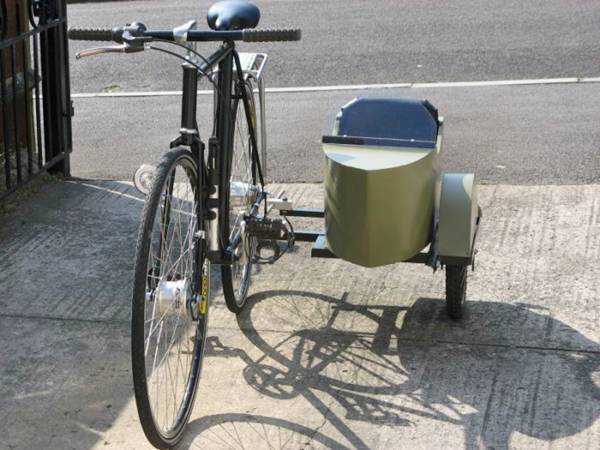
Bicycle with Sidecar


This is not a movie "about the Germans and not the old Soviet great - this vehicle is built not on an industrial scale and in the backyard or in the garage. This cool bike with a sidecar collected Briton Steve Bodiley his own hands. 14 more images after the break...

Water Bridge Over River — Magdeburg Water Bridge

Water Bridge Over The River : www.ritemail.blogspot.com

Magdeburg water bridge can rightfully claim to be a revolutionary breakthrough in bridge construction. The idea to build a navigable bridge that would connect Berlin with the ports on the Rhine River, originated in the distant 1870s. Prior to the creation of a specific project it came only in 1920. 04 more images after the break...

Monday, February 18, 2013

The houses of famous athletes

Athletes are not only faster and stronger than most of us, they also claim to a large scale to life than we do.
Thus, many of them can afford to live in expensive mansions and homes. All of these homes have a huge area.
Michael Schumacher
curious

Friday, February 15, 2013

The world’s steepest street

Baldwin Street, in a quiet suburban part of New Zealand’s southern city of Dunedin, is reputed to be the world’s steepest street. It is located in the suburb of North East Valley, 3.5 kilometres northeast of Dunedin’s city centre. A short straight street of some 350 metres length, Baldwin Street runs east from the valley of the Lindsay Creek up the side of Signal Hill. Its lower reaches are of only moderate steepness, and the surface is asphalt, but the upper reaches of this cul-de-sac are far steeper, and surfaced in concrete, for ease of maintenance (tar seal would flow down the slope on a warm day) and for safety in Dunedin’s frosty winters. At its maximum, the slope of Baldwin Street is approximately 1:2.86 (19° or 35%) – that is, for every 2.86 metres travelled horizontally, the elevation rises by 1 metre. The street’s steepness was unintentional. As with many other parts of Dunedin, and indeed New Zealand, streets were laid out in a grid pattern with no consideration for the terrain, usually by planners in London.

steepest street


Tuesday, November 20, 2012

Top 10 Fastest Motorcycles in the World 2010

Riding motorcycle is one of the popular hobbies in the world. It will be more prestige if it’s riding the fastest motorcycle in the world. Basically fastest motorcycle is created for the adrenaline reason. It’s so exciting for some people to speed up their motorcycle and feel the wind blow fast against their body. But not all people have the same idea about that. Riding fast motorcycle need some skill and of course body protection. For all of us, let’s just take a look at these fastest motorcycles in the world.

10. Ducati 1098s: 169 mph (271 km/h)

This motorcycle is produced by Italian Manufacturer, Ducati. It’s featured L-twin Cylinder Engine, 4 valves per cylinder Desmodromic and liquid cooled. This motorcycle can readh the top speed of 169 mph (271 km/h). The power of this Ducati 1098s is 119.3 kW (160.0 bhp) @ 9750 rpm with 6 speed chain transmission.
fastest motorcycle Ducati 1098s Top 10 Fastest Motorcycles in the World 2010
Ducati 1098s

9. BMW K 1200 S: 174 mph (278 km/h)

This BMW manufactured motorcycle is using 16 valves, 4 cylinders, DOHC, horizontal in-line, liquid cooled engine. Top speed that can be reached by this motorcycle is 174 mph (278 km/h). This motorcycle can produce 164.94 horsepower (120.4 kW) @ 10250 RPM. The transmission is using 6 speed manual transmission.
fastest motorcycle BMW K1200S Top 10 Fastest Motorcycles in the World 2010
BMW K1200S

Sunday, November 18, 2012

Concept Of Unusual Electric Car

The Rolling Stone is a futuristic creation of Russian designer Vitaly Kononov. This is innovative vehicle that will give a new face to personal transportation…

Electric vehicle features LED screens on both sides to display navigation tools and other information with a touch of your finger.for more image.........

Ant invasion


Ant invasion (9 photos)
No, no, they are not real  These are hand made decorated cups and spoons.To serve your guests some coffee in there would be a good idea. for more image............

Saturday, November 17, 2012

Tree destroys car


Tree destroys car 
 More Image.......

Elegant Yacht Concept - Cronos

Elegant Yacht Concept - Cronos
This elegant yacht concept called Cronos was designed by Simone Madella and Lorenzo Berselli, Italian students who are currently studying BYT (bike, yacht and train) class at the European Institute of Design. Cronos Yacht Design concept has received a special mention in the “Young Professional” category during the Millenium Yacht Design Award (MYDA) with special quote “interesting experimentation in expressive language applied to interior architecture, with particular to the value of wood and its use forms”. Stunningly intricate woodwork seems to grow from within the opulent interior and extend across spacious decks before pouring over into the water. Minimal and at the same time futuristic interior and exterior make this luxurious yacht an ideal for traveling.
 
Elegant Yacht Concept - Cronos 
 More Image........

Monday, November 12, 2012

Galaxy

Blue green space background for pc with planets, stars and meteorites
Picture of the galaxy with a big planet with a planetary ring of cosmic dust

The iPhone

Black Apple wallpaper with a Touchscreen iPhone

Light Apple wallpaper with iPhones in black and white

Blue sky, clouds and an iPhone with many Apps

Sunday, November 11, 2012

Baby


Pink background for pc with a little smiling baby holding a white tulip

Desktop hd wallpaper with a photo of a little boy holding a plastic bottle

Katrina Kaif Wallpapers


Katrina Kaif wearing a colorfull sexy outfit

Katrina Kaif playing a princess

Friday, November 9, 2012

An Amazing Underground Hotel in Songjiang Begins

songjiang-hotel-1
Some years ago, a British engineering firm Atkins proposed an extravagant design for a five-star hotel located deep within
a 100-meter, abandoned and half flooded pit near the base of Tianmashan
Mountain in the Songjiang District of Shanghai. Construction on the
19-story, 380-room Shimao Intercontinental Hotel finally is already
underway. Initially the hotel was expected to be completed by May, 2009,
but construction commenced only in March early this year.

The innovative design of the luxury resort hotel stands two levels higher than the rock face of the 100 meter deep quarry and includes underwater
public areas and guestrooms. Instead of draining what water there is in
the quarry, it will be flooded to become a sunken artificial
lake. Two of the hotels floors housing guest rooms and a restaurant are
to be situated underwater. An artificial waterfall will plunge down in
front of the hotel's facade and into the quarry, at least, according to
the concept images. Curved wings of the main body of the guestrooms
enclose a naturally lit internal atrium, which uses the existing rock
face with its waterfalls and green vegetation. There will also be sports
facilities and a ten-meter deep aquarium. Among other things, the hotel
will feature an extreme sports center for activities like rock climbing
and bungee jumping will be cantilevered over the quarry.


songjiang-hotel-0

The entire hotel is to be covered in a green roof, while the building will use geothermal energy for it’s electrical supply and heating. The
quarry will also provide a good source of heat control and shelter from
the environment.

“We drew our inspiration from the quarry setting itself, adopting the image of a green hill cascading down the natural rock face as a series
of terraced landscaped hanging gardens.” said Martin Jochman.

The Shanghai Shimao Property Group has so far invested US$555 million into the entire resort, and hotel rooms are expected to start at $320
per night. The hotel is scheduled to open in late 2014 to early 2015.


songjiang-hotel-2


songjiang-hotel-4

View of the pit where a five-star hotel will be built in Tianmashan, Songjiang, Shanghai, China, 13 March 2012.
songjiang-hotel-3

Related Posts Plugin for WordPress, Blogger...